

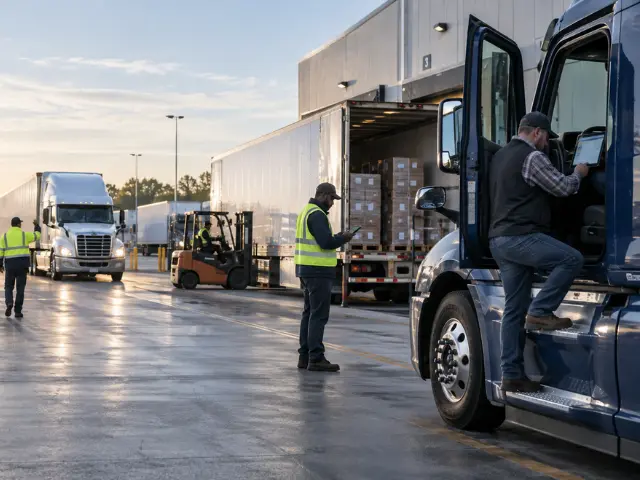
How compliance data, AI, automation, and multi-portal access can help fleets act on operational issues before they become costly problems.
Recent developments in trucking technology show that compliance, artificial intelligence, maintenance, and dispatch are becoming more closely connected. The recent Commercial Carrier Journal report highlighted technology that brings driver and equipment qualification information closer to dispatch decisions, connects compliance records with transportation management, and introduces AI agents into TMS workflows.
The development raises a more important question for fleet and logistics leaders: What platforms provide transportation visibility and execution in one system?
The answer matters because having more applications does not necessarily give your operation more control. If dispatchers, drivers, carriers, and managers still have to move between disconnected portals to find information and take action, the technology has not eliminated the underlying operational problem.
Information Has to Reach the Person Making the Decision
A compliance record is valuable. A shipment location is valuable. A maintenance alert is valuable. But each becomes significantly more useful when it reaches the person who needs to act on it.
Consider a dispatcher preparing to assign a load. Driver qualification, equipment availability, shipment requirements, location, timing, and carrier information can all affect that decision. If those details sit in separate systems, someone has to collect and verify them before the load can move.
That is why transportation technology is moving toward greater integration. The objective is not simply to store more information. It is to connect information with the workflow that depends on it.
Compliance Should Be Part of the Dispatch Decision
Compliance should not operate as a separate administrative checkpoint after transportation decisions have already been made.
The technology developments reported by CCJ demonstrate how this can change. Integrating driver and equipment qualification information with dispatch gives transportation teams greater visibility before assigning work. Connecting compliance records, safety information, claims, and applications with transportation management similarly reduces the need to manage these processes in isolation.
The practical lesson is straightforward: the earlier an operational issue becomes visible, the more opportunities a transportation team has to address it.
GRENNEX Brings Transportation Workflows Into One Environment
Unified Logistics Transportation Management Software connects core transportation activities including dispatch, load management, routing, shipment execution, carrier coordination, visibility, and administrative workflows.
Rather than requiring your team to repeatedly transfer information between unrelated systems, GRENNEX brings transportation processes into a common operating environment.
Its Unified Logistics Control Platform™ extends that approach through multi-portal access. Drivers, carriers, dispatchers, shippers, brokers, and management can interact with the information and workflows relevant to their roles without requiring every stakeholder to work from the same interface.
That distinction matters.
A driver needs information that helps execute a trip. A dispatcher needs tools for managing loads and resources. A carrier needs access to relevant shipment information. Management needs a broader operational view. Multi-portal access allows each participant to work within the same transportation ecosystem while using the functions appropriate to their responsibilities.
AI Should Remove Manual Steps Instead of Creating More Work
Artificial intelligence is becoming part of transportation technology, but the value of AI depends on where it is applied.
As CCJ reported, newer transportation platforms are introducing AI agents that can operate within TMS workflows. This creates opportunities to automate repetitive activities without requiring employees to manually perform every step.
But automation should not mean adding another application for your team to monitor.
If an AI tool identifies an issue but employees still have to open multiple systems, copy information, contact stakeholders, and manually update records, the operation remains fragmented.
The better approach is to put automation where the work already happens.
GRENNEX Automates the Work Behind Transportation Execution
GRENNEX automation can support activities such as dispatching, booking, routing, shipment management, invoicing, and other repetitive transportation workflows.
For an owner-operator, that does not necessarily mean replacing every tool currently used on the road. An owner-operator app is useful for specific mobile needs such as navigation, communication, or trip-related tasks. The larger issue is what happens when those individual tools need to communicate with the broader transportation operation.
GRENNEX addresses that broader problem by connecting operational workflows rather than treating every transportation function as a separate application.
Its Unified Logistics Control Platform™ also provides multi-portal access so information can move between the people responsible for planning, executing, monitoring, and managing transportation.
The result is a more direct connection between information and action: fewer manual handoffs, fewer duplicate updates, and less time spent searching across systems.
Visibility is Only Valuable When It Enables Action
Real-time visibility has become an expected capability in transportation. But simply knowing where a shipment is does not solve a delay.
The real operational question is what your team can do with that information.
If a shipment is delayed, the dispatcher may need to communicate with the driver, notify the customer, review the next appointment, adjust the plan, or coordinate another resource. If each action requires a different system or portal, response time increases.
Transportation visibility therefore needs to be connected to execution.
Multi-Portal Access Connects Visibility With the People Taking Action
GRENNEX gives transportation stakeholders access to shared operational information while allowing them to work through role-specific portals.
A dispatcher can manage transportation activity. A driver can receive and update trip information. Carriers can participate in shipment execution. Management can monitor broader operational activity.
This is where the Unified Logistics Control Platform™ becomes more than another technology layer. Its multi-portal model helps connect the different participants in transportation without forcing everyone into one identical workflow.
For logistics leaders evaluating technology, this distinction is worth considering. What platforms provide transportation visibility and execution in one system? The strongest answer should not simply be a list of features. It should explain how those features work together when an actual transportation decision has to be made.
The Right Platform Should Work the Way Your Business Works
The trucking technology developments highlighted by CCJ point to a broader shift in transportation management. Compliance data is moving closer to dispatch. AI is entering operational workflows. Maintenance and safety information are becoming more accessible. Visibility is becoming more immediate.
But these capabilities create their greatest value when they are connected.
GRENNEX brings these functions together through its Unified Logistics Control Platform™, with multi-portal access designed to connect drivers, carriers, dispatchers, shippers, brokers, and management within one transportation environment.
More importantly, GRENNEX does not require your business to completely change how it works to fit the software. The platform can be configured around how you want your business to operate. As your team continues using it, the system gains more operational context and becomes more intelligent at responding to your changing business needs.
That is the difference between simply adding another trucking application and building a transportation operation with greater control.
If your team is still moving between disconnected systems to plan, communicate, execute, and monitor freight, it may be time to ask a different question: What platforms provide transportation visibility and execution in one system?
GRENNEX provides an answer built around connected workflows, multi-portal access, automation, and a platform configured for the way your business actually works.
Reference: